


Should you take a fixed or variable mortgage rate?
Take a fixed rate if your home and your loan fit inside the KMRC limits and your budget couldn't carry a rise. Take a variable rate when the home is too big for those limits, or when you can absorb a rise and want the benefit when rates fall.
I ask every buyer this question before we look at a single house, whether you are in Kenya or in diaspora, because the answer changed in 2025. Since 1 September 2025, new variable shilling loans have been priced at KESONIA plus a premium the bank sets for you. KESONIA is the average rate banks charge each other overnight. Existing variable loans moved to the same model on 28 February 2026.
Three things decide it: whether the home fits a fixed-rate loan, how much a rise would hurt your budget, and how long you'll carry the loan. Most Kenyan borrowers are still on the moving kind. The Central Bank of Kenya counted 75.6% of mortgages on variable rates in 2025, down from 85.9% a year earlier.
| Factor | Fixed rate | Variable rate | Better |
|---|---|---|---|
| What sets the rate | Agreed when you sign | KESONIA plus a premium (K) the bank sets for you | Tie |
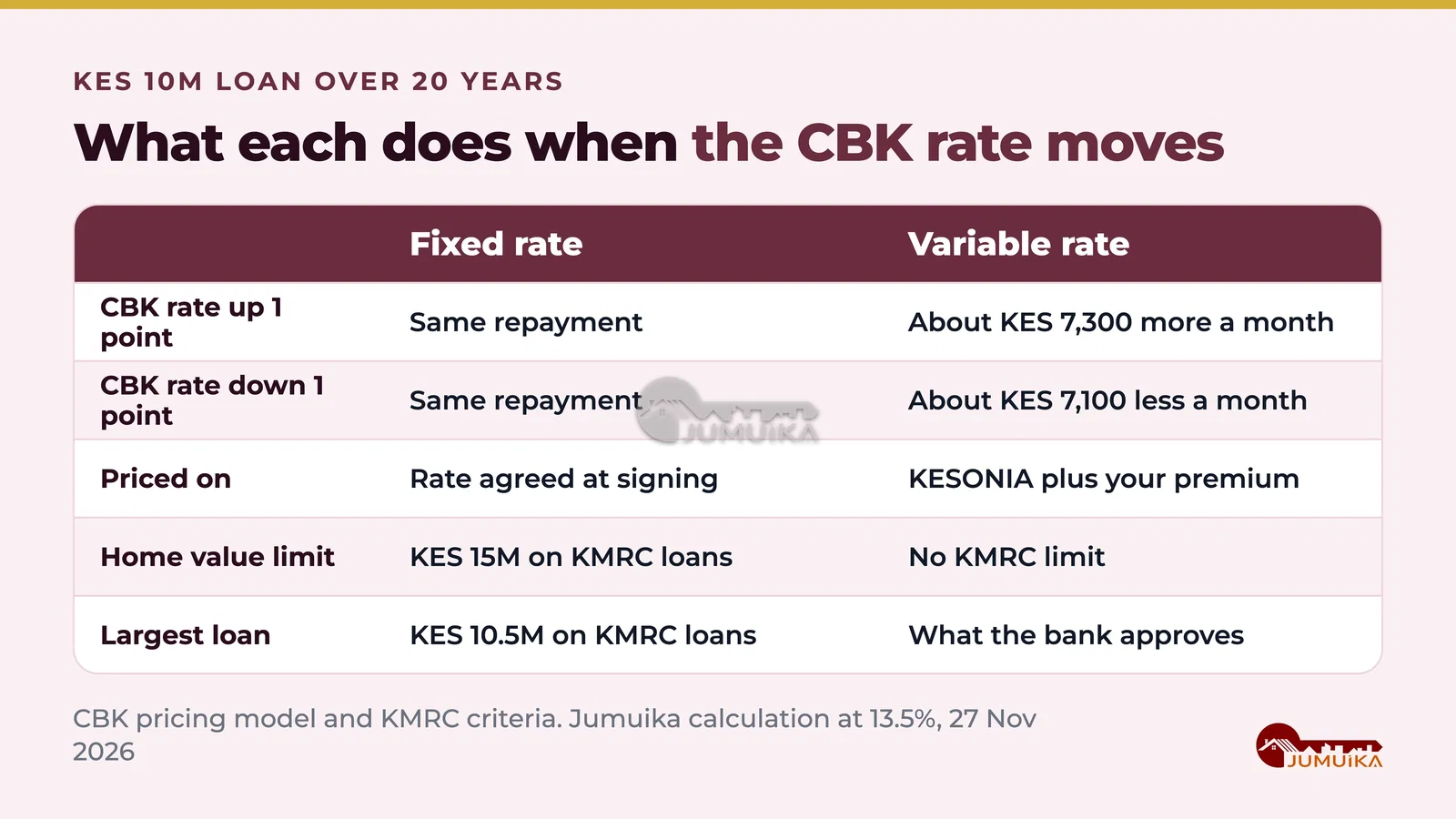
| If the CBK rate rises 1 point | Your repayment stays the same | About KES 7,300 more a month on KES 10M over 20 years | Fixed rate |
| If the CBK rate falls 1 point | Your repayment stays the same | About KES 7,100 less a month | Variable rate |
| How fast a change reaches you | It doesn't, on a loan fixed for the full term | Within the interest period: KESONIA is compounded daily | Tie |
| Rate on offer, 27 Nov 2026 | Below 10% on KMRC-backed loans; NCBA 9.5% for up to 20 years | KESONIA, 8.75% on 26 Nov 2026, plus your premium | Tie |
| Largest loan | KES 10.5M on KMRC-backed loans | Whatever the bank approves | Variable rate |
| Most the home can be worth | KES 15M | No KMRC limit | Variable rate |
| Repayment limit | Two thirds of gross monthly pay | The bank's own affordability test | Tie |
| Paying off early | KMRC permits it; NCBA charges no penalty | Ask the bank and read the offer letter | Tie |
| Interest over 20 years on KES 10M | About KES 12.4M at 9.5% | About KES 19.0M if it stayed at 13.5% | Fixed rate |
| Planning your budget | One figure for the whole term | Can change after any MPC decision, at least every two months | Fixed rate |
| Best for | Homes up to KES 15M and tight budgets | Bigger homes and budgets with room to spare | Tie |
What happens to a variable rate when the CBK rate moves?
It moves with it, and faster than it used to. A variable loan is priced at KESONIA plus your premium, and KESONIA sits almost on the Central Bank Rate. It was 8.7517% on 26 November 2026, with the CBR at 8.75%.
Your bank works out the interest by compounding each day's KESONIA over the interest period. A five-day lookback gives it time to check the figure before you're told what to pay. So a rise or a cut in the interbank rate shows up in the interest for the same period, not months later. Where KESONIA isn't practical, a loan can be priced on the CBR itself.
That's new. CBK's 2025 supervision report says that after rate caps were repealed in 2019, changes to the CBR were "not uniformly or effectively reflected in lending rates". Rates still followed in the end. Between November 2024 and September 2026 the CBR fell 3.25 points, from 12% to 8.75%, and the average bank lending rate fell 2.8 points, from 17.2% to 14.4%.
The premium is the part a bank sets. CBK says it covers the bank's lending costs, a return to its shareholders and a risk premium for you as a borrower. The bank must disclose KESONIA, the premium and the fees to you, so get all three in writing before you sign.
The next decision is due on 9 December 2026, when the Monetary Policy Committee meets. It reviews the CBR at least every two months.
What does a one-point move cost you?
About KES 7,100 to KES 7,300 a month on a KES 10M loan over 20 years. I use KES 10M because that was the average mortgage in Kenya in 2025, by CBK's count. The table shows the repayment at each rate.
| Rate | Monthly repayment | Interest over 20 years |
|---|---|---|
| 9.5% fixed (NCBA, terms up to 20 years) | KES 93,200 | KES 12.4M |
| 12.5% | KES 113,600 | KES 17.3M |
| 13.5% (CBK's 2025 average mortgage rate) | KES 120,700 | KES 19.0M |
| 14.5% | KES 128,000 | KES 20.7M |
| 15.5% | KES 135,400 | KES 22.5M |
Rates can travel further than a point. The CBR went from 8.75% in January 2023 to 13% in February 2024, a rise of 4.25 points in about a year. Had a 13.5% variable loan followed it point for point, the repayment on KES 10M would have climbed from about KES 120,700 to about KES 151,600 a month.
Then the CBR came all the way back, to 8.75% by February 2026. A variable borrower rides both legs of a cycle like that; a fixed borrower rides neither. Under the old pricing, loans didn't follow the CBR point for point, so read this as the size of the risk, not a record of what anyone paid.
What does a fixed rate protect you from, and what does it cost?
It protects you from every rise for the life of the loan, and it costs you every cut. CBK's pricing model leaves fixed rate loans out, so KESONIA never touches them.
Lenders funded by the Kenya Mortgage Refinance Company (KMRC) turn its fixed, long-term money into fixed-rate home loans at single-digit rates, CBK says. KMRC's criteria put the rate below 10% and fixed for the tenure of the loan. NCBA, one of those lenders, fixes 9.5% for terms up to 20 years and 9.9% beyond, for the full term.
On KES 10M over 20 years, 9.5% costs about KES 93,200 a month. That's about KES 27,500 less than the same loan at 13.5%, and about KES 6.6M less interest over the term if 13.5% held.
Getting out early isn't the trap people fear. KMRC's criteria permit prepayment, and NCBA says it accepts lump sums and early repayment with no penalty. Ask your own lender the same question and see the answer in the offer letter. Ask, too, whether "fixed" means the whole term or only the first years.
Borrowers are moving this way. Mortgages on fixed rates rose from 14.1% of the total in December 2024 to 24.3% in December 2025, according to CBK.
Does the home you want fit a fixed-rate loan?
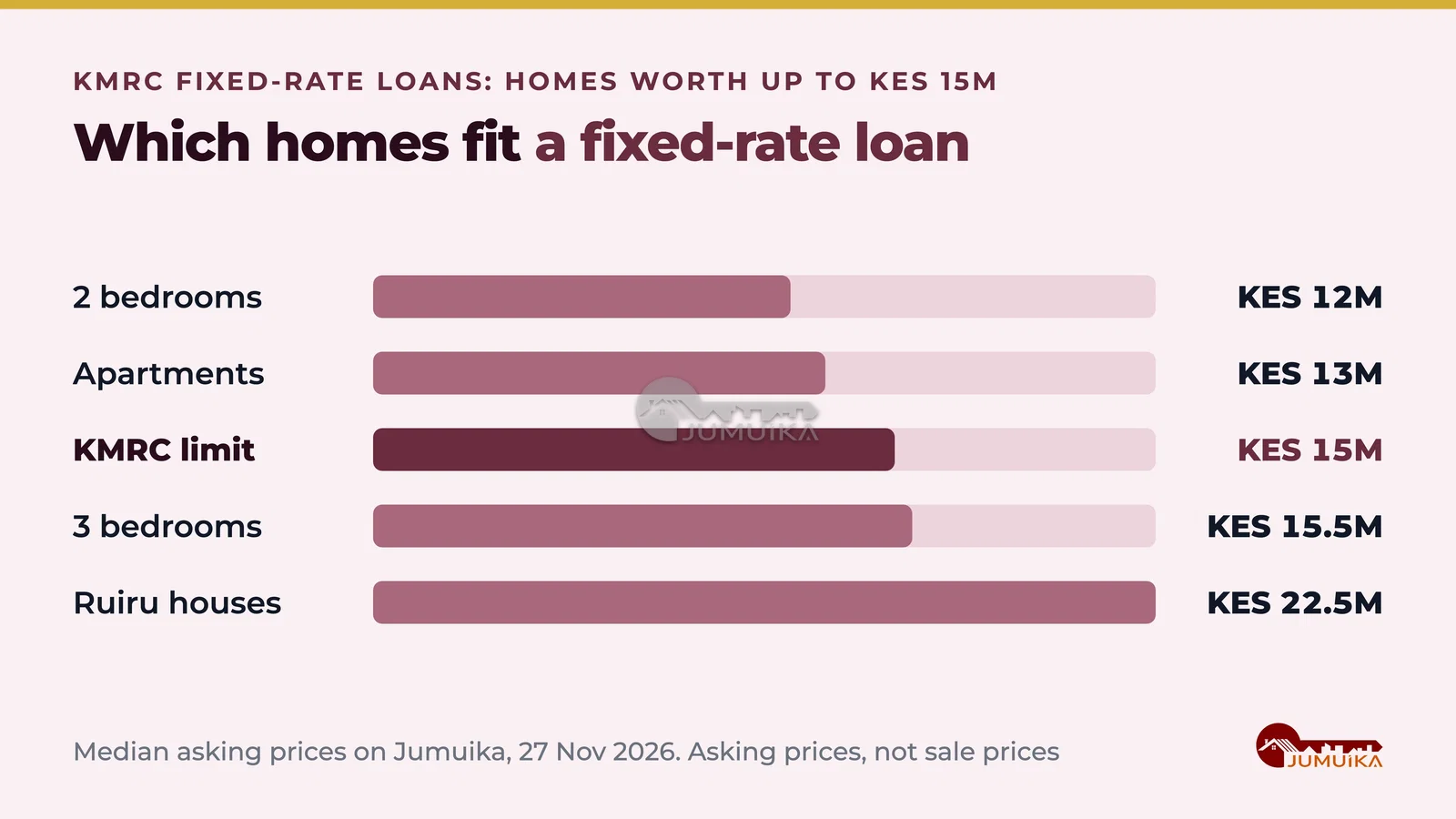
Only if it's worth KES 15M or less and you borrow KES 10.5M or less. Those are KMRC's limits, and the repayment can't pass two thirds of your gross monthly pay.
Plenty of homes on our listings fit. On 27 November 2026 the 1,284 apartments for sale across Kenya had a median asking price of KES 13M. The 459 two-bedroom homes on the market had a median of KES 12M.
Bigger homes don't. The 855 three-bedroom houses and flats for sale had a median of KES 15.5M, just over the line. Ruiru is my own patch, and the 294 houses for sale in Ruiru had a median asking price of KES 22.5M. More than half of them ask above the KMRC limit. Buyers there are choosing between a variable loan and whatever fixed offer a bank makes outside KMRC.
The loan cap bites before the price cap. On a KES 13M flat, KES 10.5M is the most these loans lend, which leaves about KES 2.5M, roughly a fifth, to find yourself. These are asking prices, not what buyers paid.
The other rules matter too. KMRC-backed loans are in shillings only, for Kenyan citizens, for a home you or your immediate family will live in. The title must be clean and free of encumbrances. I'd hold you to that one even if the bank didn't: walk away with a deed in your name, or don't sign.
Which should you choose?
Here's how I'd decide, buyer by buyer.
A first home under KES 15M
Take the fixed rate. At 9.5% on KES 10M you need a gross income of about KES 139,800 a month under KMRC's two-thirds rule, and that repayment won't change for 20 years. Check whether a flat or a house suits your budget before you settle on the size.
A house above the KMRC limits
You'll most likely borrow on a variable rate. Ask two or three banks for the premium in writing, because that's the part they set. Then test your budget against a two-point rise: about KES 14,700 more a month on KES 10M at 13.5%.
If you plan to clear the loan early
Neither kind has to lock you in. KMRC permits prepayment on the loans it funds and NCBA charges no penalty, but every lender sets its own terms, fixed or variable. The offer letter is where you find them.
Earning abroad
A KMRC-backed loan is in shillings, so a fixed rate keeps the shilling repayment still, but you carry the exchange rate on every transfer. The home must be one you or your immediate family will live in.
When you're ready to compare lenders, start with the mortgage rates each bank publishes. To see what fits under KES 15M, browse the homes for sale in Nairobi. If it's a flat, read what the apartment and condo labels mean when you buy first.
Five questions to put to the bank, and to have answered in the offer letter, before you sign.
Frequently Asked Questions
Is a fixed or variable mortgage better in Kenya?
Fixed suits a home worth KES 15M or less with a loan of KES 10.5M or less, where KMRC-backed lenders offer rates below 10%, fixed for the whole term. Above those limits most buyers borrow on a variable rate, which rises and falls with KESONIA and the Central Bank Rate.
How does the Central Bank Rate affect my mortgage?
A variable mortgage is priced at KESONIA plus your premium, and KESONIA tracks the CBR closely: 8.7517% on 26 Nov 2026 against a CBR of 8.75%. A change reaches your interest within the period it happens. A fixed mortgage isn't affected.
What is KESONIA?
The Kenya Shilling Overnight Interbank Average: the average rate at which Kenyan banks lend each other unsecured shillings overnight. CBK publishes it daily. Since 1 Sep 2025 new variable shilling loans have been priced on it plus a premium.
How much does a 1% rate rise add to a mortgage?
On a KES 10M loan over 20 years, about KES 7,300 a month going from 13.5% to 14.5%. That's our calculation on a reducing balance, before insurance and fees.
Can I repay a fixed rate mortgage early in Kenya?
KMRC's criteria permit prepayment of the loans it funds, and NCBA says it accepts lump sums and early repayment on its KMRC loan with no penalty. Other lenders set their own terms, so check the offer letter.
Sources & References
- 1. Central Bank of Kenya: Revised Risk-Based Credit Pricing Model, August 2025 (KESONIA plus premium, fixed rate loans excluded, dates, compounding and lookback). Read the pricing model
- 2. Central Bank of Kenya: Bank Supervision Annual Report 2025, pages 24, 25, 28 and 67 (Residential Mortgage Survey and KMRC). Read the annual report
- 3. Central Bank of Kenya: Monetary Policy Committee press release, 7 October 2026 (CBR at 8.75%, average lending rates). Read the MPC statement
- 4. Central Bank of Kenya: Central Bank Rate, history of decisions, read 27 Nov 2026. See the CBR history
- 5. Central Bank of Kenya: key rates (KESONIA 8.7517% on 26 Nov 2026) and notice of the next MPC meeting on 9 Dec 2026, read 27 Nov 2026. See CBK's key rates
- 6. Kenya Mortgage Refinance Company: Loan eligibility criteria, effective 1 July 2025. Read KMRC's criteria
- 7. NCBA Bank Kenya: Affordable Housing FAQs, November 2026, read 27 Nov 2026. Read NCBA's FAQs
- 8. Jumuika listings: apartments, two-bedroom and three-bedroom homes for sale in Kenya, and houses for sale in Ruiru; asking prices taken on 27 Nov 2026. Browse every home for sale


