


How much is stamp duty on land in Kenya?
Stamp duty on land in Kenya is 4% of the property's value in a city, municipality or gazetted town, and 2% anywhere else. The buyer pays it. The same 4% covers a house or an apartment in those towns, not only a bare plot.
On an ordinary plot the gap between the two rates is real money. The 1,121 listings of land for sale in Kikuyu asked a median of KES 3.5M on Jumuika on 28 Nov 2026. Kikuyu is a gazetted municipality, so the duty on that price is KES 140,000. The same price outside a municipality would pay KES 70,000.
Rural and agricultural land pays the lower rate. The 46 priced listings of agricultural land for sale asked a median of KES 4M on the same day, which at 2% is KES 80,000.
Every price in this guide is an asking price: what sellers wanted on one day, not what buyers paid. And the duty is not always worked out on the price at all. It follows the government valuation, which I come to below.
- Cities, municipalities, gazetted towns Of the property's value
- 4%
- Rural and agricultural land Of the property's value
- 2%
- To pay after signing Stamp Duty Act, section 6
- 30 days
- Penalty per three months late Capped at the duty itself
- 5%
Is your land charged 4% or 2%?
It depends on where the land lies. Inside a city, a municipality or a gazetted town the rate is 4%; outside them it is 2%.
Since April 2024 the 4% net has been much wider. In a letter dated 5 April 2024, the Principal Secretary for Lands told every land registrar to charge 4% in all gazetted towns and municipalities. It covered land, houses and apartments, and took effect at once. In those places the duty doubled, from 2%.
The list behind the letter came from the Council of Governors and names 107 cities and municipalities. Much of the commuter belt around Nairobi is on it:
- Kiambu County: Ruiru, Kikuyu, Juja, Thika, Limuru, Kiambu, Karuri and others
- Kajiado County: Ngong, Kitengela and Kajiado
- Machakos County: Machakos and Mavoko
- Further out: Naivasha, Eldoret, Nanyuki, Malindi and Diani, with Nakuru and Kisumu listed as cities
So a plot among the land on the market in Ruiru or the plots listed in Kitengela pays 4%. Nairobi and Mombasa are cities, and land there pays 4% too.
A county name on an advert is not enough to tell you the rate. Our listings of land across Machakos County asked a median of KES 3.4M on 28 Nov 2026. Inside Machakos or Mavoko municipality that pays KES 136,000; outside them, KES 68,000.
Municipal boundaries are set by gazette notice and can change, so the list can grow. Ask your advocate which side of the line the parcel falls on before you agree a price, not after.
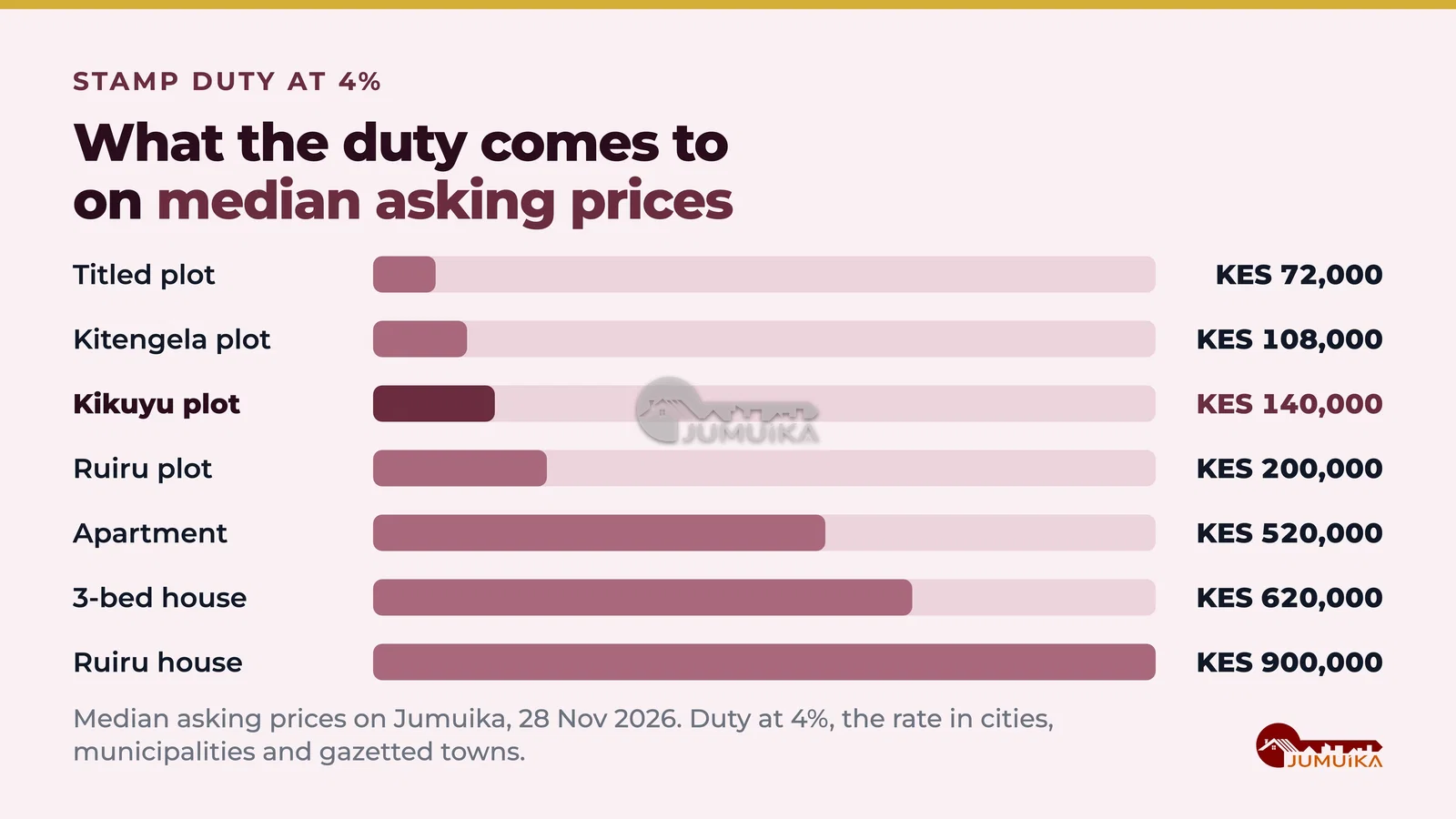
| Property | Listings | Median asking price | Duty at 4% | Duty at 2% |
|---|---|---|---|---|
| Titled plots, Kenya | 465 | KES 1.8M | KES 72,000 | KES 36,000 |
| Plots in Kitengela | 138 | KES 2.7M | KES 108,000 | KES 54,000 |
| Land in Machakos County | 236 | KES 3.4M | KES 136,000 | KES 68,000 |
| Plots in Kikuyu | 1,121 | KES 3.5M | KES 140,000 | KES 70,000 |
| Agricultural land, Kenya | 46 priced | KES 4M | KES 160,000 | KES 80,000 |
| Plots in Ruiru | 250 | KES 5M | KES 200,000 | KES 100,000 |
| Apartments, Kenya | 1,284 | KES 13M | KES 520,000 | KES 260,000 |
| Three-bedroom houses, Kenya | 855 | KES 15.5M | KES 620,000 | KES 310,000 |
| Houses in Ruiru | 294 | KES 22.5M | KES 900,000 | KES 450,000 |
| Houses in Nairobi | 6,399 | KES 65M | KES 2.6M | City rate only |
| Land in Nairobi | 2,676 | KES 70M | KES 2.8M | City rate only |
Read the 4% column for anything inside one of the gazetted towns, and for Nairobi. The median of the houses for sale in Nairobi was KES 65M on 28 Nov 2026, which pays KES 2.6M in duty; the KES 70M median of land for sale in Nairobi pays KES 2.8M.
Homes elsewhere follow the same arithmetic. The median of the apartments for sale on Jumuika, KES 13M, pays KES 520,000 at 4%. The median of the three-bedroom houses for sale, KES 15.5M, pays KES 620,000.
To check any price in your head: 4% is KES 40,000 for every million shillings of value, and 2% is KES 20,000. A KES 1.2M plot pays KES 48,000 at 4% or KES 24,000 at 2%.
Is stamp duty charged on the price or on the valuation?
On whichever is higher. Section 10A of the Stamp Duty Act sends every transfer on sale to the Chief Government Valuer, or a registered valuer the Chief Government Valuer appoints. The valuer's job is to find the property's true open market value on the date of the transfer.
If that value is above the price in your agreement, the Collector writes to you, the buyer, for the extra duty. You have 21 days from the date the notice is posted to pay it. Until you do, a caveat or restriction is registered against the title.
Here is how that plays out. Say you agree KES 3M for a Kikuyu plot and the valuer puts it at KES 3.5M, the median asking price there in November 2026. You pay 4% of KES 3.5M, which is KES 140,000, instead of KES 120,000 on the price. That is KES 20,000 more, due within three weeks.
The valuation itself costs nothing. The State Department for Lands says government valuers carry it out free, from a valuation request, the title, the transfer document, a search, a map and plans.
Section 10A covers gifts too, so the valuer's figure follows the land however it changes hands.
When and how is stamp duty paid?
You pay within 30 days of signing the transfer, and you pay online on Ardhisasa, the Ministry of Lands' land platform. Section 6 of the Stamp Duty Act starts the 30 days on the day the document is first signed. If you signed it abroad, they start when it first reaches Kenya.
If the assessment was asked for inside those 30 days, the duty is due within 21 days of the notice of assessment instead.
The paper route has closed. The State Department for Lands built a National Stamp Duty Module into Ardhisasa, and by 28 Dec 2025 it was running in 36 registries. From 16 Feb 2026 the registries stopped taking physical submissions, so the request, the valuation and the payment all happen on the platform.
Payment goes through ArdhiPay, which is linked to eCitizen, and the system issues an electronic receipt. Older guides that send you to KRA's iTax portal describe the route as it was before the move.
The seven steps of buying land show where stamp duty sits among the rest of a purchase.
-
Sign the transfer
The 30 days in section 6 run from the day the transfer is first signed, or first received in Kenya if it was signed abroad.
The 30-day clock starts
-
Request the valuation on Ardhisasa
The State Department for Lands asks for a valuation request, the title, the transfer document, a search, a map and plans.
Government valuation: free
-
Receive the valuation and assessment
A government valuer sets the open market value. The duty is charged on that figure or on the price, whichever is higher.
Extra duty: due within 21 days of the notice
-
Pay on ArdhiPay
Payment is online through ArdhiPay, which is linked to eCitizen. The system issues an electronic receipt.
4% or 2% of the value
-
Lodge the transfer
The registry asks for the stamp duty receipt with the executed transfer and the original title. It also wants ID or passport, PIN certificate, rent clearance, consent where it applies and two passport photos.
KES 1,000 plus a KES 2,500 title fee
What happens if you pay stamp duty late?
You pay a penalty of 5% of the duty for every three months you are late, and the transfer is not registered until you pay. Section 20 of the Act charges one shilling for every twenty shillings of duty, for each period of three months after the deadline.
Part of a period counts as a whole one, and the penalty stops growing when it equals the duty. On the KES 140,000 due on a median Kikuyu plot, paying five months late adds two periods: 10%, or KES 14,000. Leave it five years and the penalty matches the duty itself.
The Collector may waive up to KES 1.5M of penalty. You would still be asking for a favour you never needed.
The larger cost is legal. KRA says an unstamped instrument leaves the transaction invalid, and the document cannot be used as evidence in court. The registry also wants the stamp duty receipt before it registers the transfer. A buyer who has paid the price but not the duty holds a signed agreement, not a registered title.
Who does not pay stamp duty?
A few transfers are exempt, and most of them stay within a family. KRA lists a transfer between spouses, family property passed on after the registered owner dies, and family property moved into a company the family wholly owns. It adds gifts of land to charitable organisations.
Section 117 of the Act exempts others, among them:
- a will, codicil, registered family trust or other testamentary disposition;
- the purchase of a house by a first-time home owner under the affordable housing scheme;
- land bought to build or expand an educational institution, with duty payable if the land later goes to another use.
Watch two points. The first-time buyer exemption covers a house bought under the affordable housing scheme, not every first home. And a gift is not free: section 52 charges a gift of land between living people as if it were a sale, on the property's value. Handing a plot to your son or daughter pays duty unless an exemption applies.
KRA describes these as exemptions that may be obtained, so they have to be claimed. Ask your advocate to raise the exemption before the duty is assessed, with the documents that show you qualify.
Will land under KES 1 million stop paying stamp duty?
Not yet. On 20 Oct 2026, at the Mashujaa Day celebrations in Eldoret, President Ruto proposed exempting land deals of KES 1 million or less from stamp duty. Higher-value deals would pay progressive rates. It needs policy and legal changes before it takes effect. Until then the 4% and 2% rates apply.
The saving would be KES 40,000 on a KES 1M plot at 4%, or KES 20,000 at 2%. Many buyers would sit above the line anyway: the 465 titled plots on Jumuika asked a median of KES 1.8M on 28 Nov 2026, so more than half ask over KES 1M.
The announcement gave no figures for the higher bands. If your deal is near KES 1M, ask your advocate whether the change has passed before you sign.
What else do you pay the government when you buy?
Stamp duty is the large item. The State Department for Lands lists the other transfer charges as KES 1,000 and a title fee of KES 2,500.
If you borrow, the charge, meaning the mortgage registered against your title, carries stamp duty as well. Absa lists it at 0.10% of the loan, about KES 10,000 on a KES 10M mortgage. Compare mortgage rates bank by bank before you choose a lender.
Duty is the last thing you pay, not the first. Confirm the seller owns what they are selling with the nine due diligence checks before you sign anything that starts the 30-day clock. Every figure above assumes a clean title.
When you compare prices, all land for sale in Kenya and houses for sale across Kenya on Jumuika show the asking price. Add 4% or 2% and you have the government's share.
Frequently Asked Questions
Who pays stamp duty on land in Kenya, the buyer or the seller?
The buyer. Stamp duty on a transfer on sale is paid by the purchaser. Section 10A of the Stamp Duty Act also sends any demand for extra duty after the valuation to the purchaser or transferee.
Is stamp duty in Kenya 2% or 4%?
4% of the value for land, houses and apartments in a city, municipality or gazetted town, and 2% for land elsewhere. Since April 2024 the 4% rate covers 107 gazetted cities and municipalities, among them Ruiru, Kikuyu, Thika, Ngong, Kitengela and Machakos.
How much is stamp duty on a KES 1.2M plot?
KES 48,000 at 4% or KES 24,000 at 2%, if the government valuer agrees with the price. If the valuer puts the plot higher, the duty is worked out on the valuer's figure.
How long do I have to pay stamp duty?
30 days from the day the transfer is first signed, under section 6 of the Stamp Duty Act. After that the penalty is 5% of the duty for every three months, or part of three months, until it equals the duty.
Is a transfer of land to my spouse exempt from stamp duty?
KRA lists a transfer of property between spouses as an exemption that may be obtained, as is family property passed on after the registered owner dies. A gift to a child is charged as if it were a sale, on the property's value, unless an exemption applies.
Sources
- 1. Jumuika listings: land, houses and apartments for sale in Kenya, Nairobi, Kiambu, Kajiado and Machakos, asking prices and listing counts taken on 28 Nov 2026. See the listings
- 2. State Department for Lands and Physical Planning: Land Transfers (charges and requirements), read 28 Nov 2026. Read the page
- 3. State Department for Lands and Physical Planning: Valuation for Stamp Duty, read 28 Nov 2026. Read the page
- 4. Kenya Revenue Authority: stamp duty questions (due date, penalty, non-payment), read 28 Nov 2026. Read the page
- 5. Kenya Revenue Authority: what instruments are assessed for stamp duty, and exemptions, read 28 Nov 2026. Read the page
- 6. Stamp Duty Act (Cap. 480), section 6: time of stamping. Text on Sheriaplex, read 28 Nov 2026. Read the section
- 7. Stamp Duty Act (Cap. 480), section 10A: valuation by the Government Valuer. Text on Sheriaplex, read 28 Nov 2026. Read the section
- 8. Stamp Duty Act (Cap. 480), section 20: stamping out of time. Text on Sheriaplex, read 28 Nov 2026. Read the section
- 9. Stamp Duty Act (Cap. 480), section 52: duty on gifts. Text on Sheriaplex, read 28 Nov 2026. Read the section
- 10. Stamp Duty Act (Cap. 480), section 117: exemptions. Text on Sheriaplex, read 28 Nov 2026. Read the section
- 11. CMS (law firm): The Ministry of Lands raises stamp duty on land transfers, 15 Apr 2024, with the list of gazetted cities and municipalities. Read the article
- 12. Citizen Digital: Lands Ministry rolls out digital stamp duty processing system in 36 registries, 28 Dec 2025. Read the article
- 13. HapaKenya: Kenya moves stamp duty services online to ArdhiSasa platform, 19 Feb 2026. Read the article
- 14. The Star: Ruto proposes scrapping stamp duty on deals up to Sh1 million, 20 Oct 2026. Read the article
- 15. Absa Bank Kenya: Get a home loan (costs of a home loan), read 28 Nov 2026. Read the page


